Showing posts with label Information. Show all posts

Thursday, November 11, 2010

Photos of Mount Merapi Eruption

Since its initial eruptions on October 25th, Indonesia's Mount Merapi continues to spew hot gases and ash as far as 5,000 meters into the atmosphere, wreaking havoc on surrounding villages and farms, and disrupting air travel - and more than 140 people have been killed by the eruptions over the past two weeks. Hundreds of thousands of residents have been displaced, many of them living in temporary shelters until the Indonesian government reduces the existing 20 km "safe zone", and allows them and their livestock to return. Collected here are recent images from the area near the unpredictable Mount Merapi as it still rumbles and erupts. (39 photos total)

m01_25783021

A farmer stands in a rice field as volcanic material from Mount Merapi erupts, in Klaten, Central Java on November 4, 2010 near Yogyakarta, Indonesia. Over 70,000 people have now been evacuated with the danger zone being extended to over 15km as the volcano continues to spew ash and volcanic material. (Ulet Ifansasti/Getty Images)

m02_25733947

2. Mount Merapi volcano spews smoke as seen from Deles village in Klaten, near the ancient city of Yogyakarta, November 1, 2010. (REUTERS/Dwi Oblo) #

m03_25813529

3. Houses are in flames as volunteers rescue burned victims of an eruption of Mount Merapi in Argomulyo village early on November 5, 2010. (SUSANTO/AFP/Getty Images) #

m04_25813621

4. Volunteers rescue burned victims of Mount Merapi eruption in Argomulyo village, devastated by deadly hot clouds of volcanic ash early on November 5, 2010. (SUSANTO/AFP/Getty Images) #

m05_25809635

5. Lightning strikes as Mount Merapi erupts, as seen from Ketep village in Magelang, Indonesia's Central Java province November 6, 2010. (REUTERS/Beawiharta) #

m06_25807735

6. Dead trees and ash cover a damaged house with the erupting Mount Merapi in the background in Sleman, Yogyakarta province, central Java, on November 6, 2010. (BAY ISMOYO/AFP/Getty Images) #

m07_25794813

7. A pair of shoes sit covered in volcanic ash from the eruption of Mount Merapi in the abandoned village of Kaliadem, Yogyakarta, Indonesia on Nov. 2, 2010. (AP Photo/Trisnadi) #

m08_25807859

8.  Survivor Sri Sucirathaasri, 18, stands beside her injured sister Prisca in a hospital in Yogyakarta, Indonesia on Nov. 5, 2010. The hospital at the foot of Indonesia's most volatile volcano is struggling to cope with victims brought in after the mountain's most powerful eruption in a century. (AP Photo/Achmad Ibrahim) #

m09_25827165

9. Villagers gather at the grave of the victims of Mount Merapi eruption for a mass burial at Sleman, Yogyakarta, Indonesia, Sunday, Nov. 7, 2010. (AP Photo/Achmad Ibrahim) #

m10_25806403

10. A villager takes a stroll at Ketep village in Magelang, Indonesia's Central Java province, November 6, 2010, as Mount Merapi volcano erupts spewing out towering clouds of hot gas and debris in the background. (REUTERS/Beawiharta) #
m11_25807733

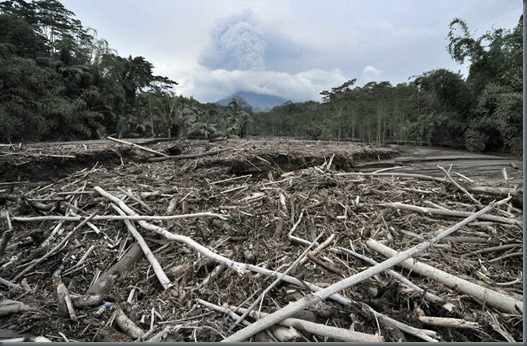
11. Dead trees and mud clog a river as clouds of hot ash spew from the erupting Mount Merapi in Sleman, central Java, on November 6, 2010. (BAY ISMOYO/AFP/Getty Images) #

m12_25821575

12. Volcanic ash from the eruption of Mount Merapi covers a village in Muntilan, Central Java, Indonesia, Sunday, Nov. 7, 2010. (AP Photo/Trisnadi) #

m13_25824677

13. A search and rescue team looks for victims at Wukirsari village in Sleman district in the Indonesian Central Java province November 7, 2010. (REUTERS/Sigit Pamungkas) #

m14_25810483

14. A kitchen is covered by ash in Cangkringan village off the Indonesia's Central Java province, November 6, 2010. (REUTERS/Dwi Oblo) #

m15_25794807

15. A pet bird, killed during the eruption of Mount Merapi, lies in its cage in the abandoned village of Kaliadem, Yogyakarta, Indonesia on Nov. 2, 2010. (AP Photo/Trisnadi) #

m16_25794817

16. A melted radio-cassette tape recorder sits covered with volcanic ash from the eruption of Mount Merapi in the abandoned village of Kaliadem, Yogyakarta, Indonesia on Nov. 1, 2010. (AP Photo/Trisnadi) #

m17_25794985

17. Bodies of victims of an eruption of Mount Merapi rest amongst ashes and debris in front of a house in Argomulyo village, Cangkringan, in Sleman November 5, 2010. (REUTERS/Aditia Surya) #

m18_25791063

18. Rescuers remove the charred remain of the body of a victim of Mount Merapi eruption in Argomulyo, Yogyakarta, Indonesia, Friday, Nov. 5, 2010. (AP Photo/Trisnadi) #

m20_25691269

19. An Indonesian veterinarian tends to a cow injured after Mouth Merapi's eruption in the village of Umbulharjo, in Sleman, central Java, on October 29, 2010. (ADEK BERRY/AFP/Getty Images) #

m21_25762375

20. Molten lava flows from the crater of Mount Merapi captured in this long exposure photograph taken from Klaten district in Central Java province late on November 2, 2010. (SONNY TUMBELAKA/AFP/Getty Images) #

m22_25763211

21. Mount Merapi spews lava and smoke as it erupted again on Wednesday as seen from Sidorejo village in Klaten on November 3, 2010. (REUTERS/Beawiharta) #

m23_25703203

22. Residents ride their motorcycles in Yogyakarta, blanketed by volcanic ash falling from Mount Merapi's latest eruption early on October 30, 2010. (CLARA PRIMA/AFP/Getty Images) #

m24_25702897

23. A woman wearing a raincoat, rides a bicycle on an ash-covered road after another eruption of Mount Merapi volcano, in the city of Yogyakarta October 30, 2010. (REUTERS/Andry Prasetyo) #

m25_25792687

24. Villagers flee their homes following another eruption Mount Merapi in Klaten ,Indonesia, Friday, Nov. 5, 2010. (AP Photo/Achmad Ibrahim) #

m26_25776377

25. Mount Merapi erupts, as seen from Wukirsari village in Sleman, near the ancient city of Yogyakarta, November 4, 2010. (REUTERS/Beawiharta) #

m27_25664321

26. Stumps are all that remain of trees felled by an eruption of Mount Merapi, at Kinahrejo village in Sleman, Indonesia on October 27, 2010. (Ulet Ifansasti/Getty Images) #

m28_25734567

27. Residents leave a danger zone as Merapi volcano releases ash clouds above Balerante village, Klaten on November 1, 2010. (ADEK BERRY/AFP/Getty Images)#

m29_25734579

28. Villagers escorted by police carry a suspected looter caught in an abandoned village in Sleman located in Mount Merapi's danger zone on November 1, 2010. (ARYA BIMA/AFP/Getty Images) #

m30_25701975

29. Indonesian soldiers of Special Force of Kopassus evacuate an elderly woman who refuses to leave her home during an evacuation after a new violent explosion in Umbulharjo, Sleman on October 30, 2010. (ADEK BERRY/AFP/Getty Images) #

m31_25794213

30. A woman prays in a temporary shelter at Maguwoharjo Stadium in Yogyakarta, November 5, 2010. (REUTERS/Beawiharta) #

m32_25824683

31. Refugees rummage through second-hand clothes that were distributed at a refugee camp in Yogyakarta, Central Java November 7, 2010. (REUTERS/Sigit Pamungkas) #

m33_25795913

32. A girl weeps at a temporary shelter for those who are affected by the eruption of Mount Merapi in Bawukan, Indonesia, Friday, Nov. 5, 2010. (AP Photo/AK Hendratmo) #

m34_25782909

33. Refugees look out from inside a tent during rain at a temporary evacuation center set up as a result of the repeated eruptions of Mount Merapi, in Keputran village, Klaten, Central Java on November 4, 2010. (Ulet Ifansasti/Getty Images) #
m35_25801031

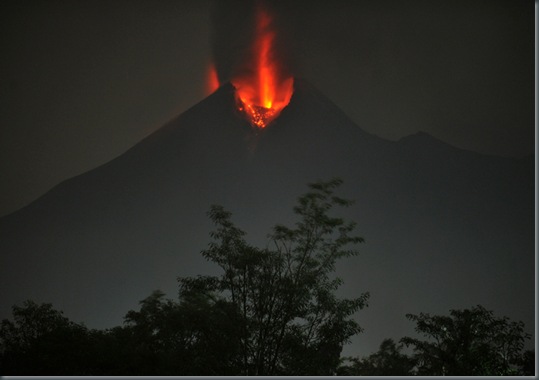
34. Lava and ash spews from the top of Mount Merapi, viewed from Klaten district in Central Java province before dawn on November 6, 2010. (BAY ISMOYO/AFP/Getty Images) #

m36_25779177

35. A view from a domestic flight from Denpasar to Yogyakarta that was subsequently diverted to Surabaya airport shows a plume of gas and ash billowing some 10 km (six mi) high from Mount Merapi, during an eruption on November 4, 2010. (CLARA PRIMA/AFP/Getty Images) #

m37_25841227

36. Search and rescue team members from Yogyakarta carry a victim of Merapi volcano's eruption at the village of Ngancar in Sleman on November 8, 2010. (CLARA PRIMA/AFP/Getty Images) #

m38_25796941

37. The hand of a victim of the eruption of Mount Merapi, among body bags at a hospital morgue in Yogyakarta, Indonesia, Friday, Nov. 5, 2010. (AP Photo/Slamet Riyadi) #

m39_25842621

38. A farmer walks through his corn field covered in volcanic ash from Mount Merapi eruption in Muntilan, Central Java, Indonesia on Monday, Nov. 8, 2010. (AP Photo) #

m40_25733763

39. Mount Merapi, viewed from Sidorejo village in Klaten on November 1, 2010. (REUTERS/Beawiharta) #

Monday, November 8, 2010

An Actor with Masked mistakenly Shot Dead

Perhaps because of very good in the act, a Filipino citizen does not know that an actor is performing in his village. As a result, these actors have been killed, hit by a shot because the masked killer mistakenly perceived as members of the herd.

CNN news reported that this incident occurred in a village in Cebu, central Philippines, when a British company was producing a film titled "Going Somewhere".

Actor Kirk Abella, 32, is required to act as a masked robber with a motorcycle. Abella also brought a toy gun to support his role.

Eddie Cuizon, 52, a security guard in the village, said he was not informed in advance about a movie being filmed in the area.

Parian district police chief, Alexis Relado, said that Cuizon shot Abella when this Filipino veteran actor is trying to escape. In fact, according to Relado, Abella was in acting.

Cuizon said that he just got up and did not realize what was happening. He is the middle to tighten oversight of the village following a number of reports gunmen in the area. Most murders in the streets of the Philippines conducted by masked riders.


Viewing Abella as the masked robber, he then tried to stop the actor motor. However, Cuizon said, instead of stopping, Abella even just step on the gas and injuring Cuizon knee. This village guards cash out his gun and fired. Abella dying in place.

Cuizon detained by police on charges of murder and violations of the laws of firearms ownership. Meanwhile, British director Alan Lyddiard who worked on the film can not be questioned about the incident that befall the actors.

Why Our Body Liquid Taste Different

Not many people know or realize the magic of what we had: tears, ear, and saliva. This scientific fact is sometimes overlooked, even though all three have different functions that are created so by the Creator so that we can live very well.

[Image: 
eye_ear_mouth.gif]


Salty taste of Tears

Tears taste salty because it implies that includes leusinenkefalin, adrenocorticotropic, and prolactin and some electrolytes, protein and fat binding immunoglobulin. Collectively, this produce taste salty.

The main function of all this is to maintain the condition of the whole eye in order to remain stable. Fat-binding proteins themselves make the outermost layer consisting of layers of fat that works to protect the eye moisture intact.

Ear Liquid taste Bitter


Our ears liquid taste bitter , it is actually a result of secretion from the glands in the ear that is alkaline and sticky. This secretion allows the ear that hole was always open and without cover,  when insects or other small creatures enter it, it make them can not bear to linger in it and get out of the ear.

Sticky liquid tends to make small objects that enter to the ear hole tend to be trapped and can be released as earwax.

Fresh saliva taste

Our saliva taste fresh. This is because the function thereof is related to the taste of the food we eat. Can you imagine if we changed saliva taste? Very, very uncomfortable at all sure in time to eat food.

This, too, would you feel when you are sick. Drinking fresh water also taste bitter. Very uncomfortable. Saliva contains several proteins and enzymes and antibacterial substances.
At the time you get sick, the content of the saliva changed such that the composition of it tends to produce a slightly alkaline fluid. This is why you feel the bitter taste when ill and very uncomfortable when eat food.

Sunday, November 7, 2010

Newly Found Species, Monkey with The Nose Facing Upward

Species of unknown type is usually very difficult to trace. The researchers now are looking for a new primate species in northern Myanmar.

But the researchers are convinced by the local population that rare monkeys are not hard to find. They just have to wait until it rains.

http://www.treehugger.com/Myanmar%20snub-nosed%20monkey.jpeg

This new species, previously known as a kind of pug-nosed monkey named Rhinopithecus Stykeri, have a nose that facing upward, thus making the animal sneezed loudly when rain falls.
According to local hunters, to avoid water entry, a new type of monkey is sitting with their heads enclosed position with their knees. Similarly, as quoted by LiveScience.

This discovery was made by biologists from the Myanmar Biodiversity and Nature Conservation Association, primate experts from Fauna and Flora International, and the people of the People Resources and Biodiversity Foundation.

The research team previously worked for a gibbon monkey survey in southeastern Myanmar in early 2010, and the local residents informing them about the new monkey species.

http://i.okezone.com/content/2010/10/27/56/387172/mnjBRD8pMO.jpg

Based on the description of these villagers, scientists directly looking monkeys that were previously only found in China and Vietnam. Some locals even showed evidence of a skull and bones.

The monkey is about 55 cm long with a tail length of 78 cm, pink-faced, black-haired and mustachioed white.

The locals call these monkeys as 'Myuk Na Tok Te' or 'Mey Nwoah', both meaning 'monkey with  nose upwards'.The monkeys live in separate areas with other species, bordered with two rivers.
The discovery of these animals immediately received status as endangered by the International Union for Conservation of Nature.

Friday, November 5, 2010

Fish with Hand, didn’t Swim, but Walking

All fish shown below is very unique, because usually fish is swim, but rather than swim, this fish “walk” using their two fin that usually used to swim.

This kind of fish found about 1900, in the bottom of Tasmania Sea, an Australian Island.

The pink fish only 4 Inch length. It’s very small…


handfish4

Interesting, isn’t it?

Friday, October 22, 2010

Beautiful and deadly Amazon Animals

World Wildlife Fund has documented more than 1,200 identified species of the Amazon between 1999 and 2009 in a report entitled "The Amazon is Alive!" Here’s some of their document report..


Poisonous Frog

Poison-arrow frog Ranitomeya Benedicta, is a colorful frog,  was discovered in 2008 in Peru. Poison-arrow frog emit  toxins that can be adapted for medical purposes as a painkiller.

icys8bk4

A Color Spot

The view of the eagle-woods vague (Micrastur mintoni),  look at highlights of  the bright orange skin around the eyes. This birds found in Brazil in 2002, but scientists still do not know much about this species.

slroyxz3

Not Easy to Be Geen

This lizard species are known as Anolis cuscoensis discovered in 2008 in the Peruvian Andes Amazonia. Anoles have the ability to change their skin color, just like a chameleon, but that's not necessarily a good thing.Green anoles turn brown when they are stressed or ill

yvewht5o

Newly Found Frog

The frog, which is known as Osteocephalus castaneicola identified as a new species after its discovery in the Bolivian Amazon in 2009.

acltgz8p

Fish with Mohawk Style

Apistogramma baenschi is one of at least 257 new fish species found in the Amazon River and its tributaries over the past decade.This breed of fish, found in Peru in 2004, made a water splash with their brightly colored fins.


pgzaackr

Freaky…. or Afraid?

Braunshauseni avicularia, found in Brazil in 1999, including in a tarantula class known as "pinktoes" because they are typically colored soles. Tarantula avicularia are not considered aggressive.They prefer to jump and run away as fast as possible when threatened. They will sometimes respond to the threat by launching jets from their dirt which can accurately hit a target 3 feet (1 meter) away.

u0kixeae

Study in Red and Brown

This land snakes, Atractus tamessari, has been identified as a new species in 2006 after its discovery in Guyana. Has a characteristic color pattern of irregular red markings on the medium brown on black leather, with black-and-yellow belly.

et9dfmpu

Green Frog from Guinea

This frogs are known as Liliae hypsiboas, have bright green skin which is tinged with blue. This species was first identified in 2006 on the east bank of Pakaraima Mountains Guinea.

g8yx8eba

Monkey’s Gaze

Rio Acari marmoset (Mico acariensis) was identified as a new species in 2000. The specimen was first seen by scientists are being kept as pets by residents of a small settlement near the Rio Acari in Brazilian Amazonia.

hgkryyg7

Glass Frog

Frog species known as Wileyi nymphargus first described in 2006 in the Ecuadorian Amazon. This frogs are known as "glass frog": Although they have a general background of lime green color of life, their abdominal skin can be transparent  - revealing the liver, heart and digestive tract.

1arbdln4

Polly want some Leather?

Bald parrot (Pyrilia aurantiocephala) caused a sensation when described in 2002, mainly because it is difficult to believe that such a big bird and colorful escaped the observation of the world for so long. This Brazilian birds has a remarkable bald head with no feather at all, but colorful feathers elsewhere.


4dvndgag


Sitting on the Trees

This slim-legged treefrog (Osteocephalus yasuni) was first identified as a new species in 1999. It has been found in Ecuador, Peru and Colombia.


sisjol0j